FSCC Board Reviews CDL Program, Approves Construction Grant Project, and Advances Athletics Growth


Fort Scott, KS – The Fort Scott Community College Board of Trustees met February 16 to review program updates, approve key initiatives, and outline next steps for institutional growth and workforce development.


Board members received a comprehensive update on the college’s Commercial Driver’s License (CDL) program, which has been reestablished in Bourbon County. The six-week program operates under the federally required Entry-Level Driver Training (ELDT) model and reports strong enrollment momentum, with new cohorts cycling approximately every six weeks.


The program highlighted high job placement outcomes and growing industry demand, citing a significant nationwide truck driver shortage. Trustees discussed pursuing state recertification that would allow the college to administer final CDL exams in-house, creating additional revenue opportunities and streamlining student completion.


The Board formally accepted a warranty deed tied to a $528,000 frame grant that will fund the construction of duplex housing units. The project will support the college’s construction trades program, providing hands-on learning opportunities for students in all phases of the build, from foundation to finishing work. Plans call for constructing four total living units, with two completed per year. The strategy includes building one duplex immediately and partially enclosing a second structure to allow for an expedited build in Fall 2026. An RFP for a general contractor was approved to move the project forward.


The Board was introduced to several new coaches across multiple sports programs, including soccer, softball, and track and field. Officials reported roster growth and projected that new and expanding athletic programs could bring an additional 120–130 students to campus. The softball team has already opened its season with a 2-0 record, and the newly established track and field program is rapidly building participation numbers.


During the meeting, trustees approved scholarship proposals as recommended by the scholarship committee, authorized the presentation of an honorary associate degree to Jack Gilmore, accepted the warranty deed for the frame grant site, and approved the contractor RFP for the project.


The meeting also included the Pledge of Allegiance, prayer, and roll call, with trustees Bailey, Brown, Cosens, Hoyt, McKinnis, and Ropp recorded as present.


The February meeting reflected continued momentum for FSCC in workforce training, athletics expansion, and infrastructure development as the college advances strategic growth initiatives across its campuses.


###

From the Bleachers – 752 by Dr. Jack Welch

FROM THE BLEACHERS-752

BY DR. JACK WELCH

 Interceding Leadership.

In Mark chapter 6, Jesus sends His disciples straight into a storm. He knew it was coming. While they were out on the sea straining at the oars, He was up on the mountain praying for them. He saw them. He wasn’t surprised by the wind, and at the right time, He came to them.

That’s leadership. A real leader doesn’t stand on the shoreline pointing out what everyone is doing wrong. When people are grinding and the wind is in their face, a leader sees it. He steps in. He guides. He helps steady the boat.

In Good to Great, Jim Collins talks about Level 5 leaders, men and women who combine strong resolve with real humility. They’re tough-minded, but they’re not self-centered. They make hard decisions, but they don’t beat their chest about it. When things go wrong, they own it. When things go right, they pass the credit. That’s the kind of leadership that lasts.

Accountability matters. Standards matter. Results matter, but there’s a difference between coaching someone up and constantly pointing fingers. Most good employees want to do well. Sometimes they just need clarity. Sometimes they need development. Sometimes they need someone willing to stand in the gap long enough to help them grow.

Strong leaders don’t just endure storms. They pray for others in their storms. Leadership is not a solo act. If an organization is going to move forward, everybody has to buy into the mission. We won’t agree on every detail. Every idea won’t be exactly how I would draw it up, or how you would. That’s fine. That’s collaboration, but once we set direction, we pull together. When talented people line up behind a shared purpose and support the plan, even if it wasn’t their first choice, progress speeds up. When everyone pulls the same way, success isn’t luck. It’s the outcome.

I like to say we can hang on the rope together and hold each other up. When we communicate honestly and accept coaching, the climb is hard but manageable, but if someone insists on climbing alone, rejecting feedback and pushing back on accountability, the weight gets too heavy. Eventually, they fall by themselves. Guiding good employees can make them great, but if someone refuses direction, accountability rests on their shoulders.

Leadership isn’t about shouting from the shore. It’s about seeing clearly, guiding patiently, and stepping into the storm with your team. Real strength isn’t loud. Real strength kneels.

Thought for the Week:
“Stepping into the storm with your team is far more powerful than leading from the shore.”   Jack Welch

Dr. Jack Welch serves as President of Fort Scott Community College. With a career spanning professional sports, public education, and rural community development, he brings a servant-leader mindset and a passion for building trust-driven cultures that empower people to thrive in the classroom, on the field, and in life. He is also the author of Foundations of Coaching: The Total Coaching Manual.

Naloxone Dispenser Installed at FSCC Through Statewide Partnership


Fort Scott, KS – Naloxone saves lives. In 2024, 559 Kansans tragically died from drug overdoses—many related to opioid misuse. In response to this ongoing crisis, the Kansas Attorney General’s Office, in partnership with Emily’s Hope, is delivering Naloxone dispensers to colleges and universities across the state, including one to Fort Scott Community College.


The Naloxone dispenser at FSCC provides access to a life-saving medication that can reverse the effects of an opioid overdose. Making Naloxone readily available on campus is part of a broader statewide effort to reduce overdose deaths, increase awareness, and provide immediate tools to help in emergency situations.


College officials encourage students, employees, and community members to be aware of this resource. Naloxone is safe to use and can be administered in an emergency while waiting for first responders to arrive.


“If this could help you, your family, or your neighbors, please remember it’s here,” college representatives shared. “Access to Naloxone is about protecting lives and supporting the well-being of our community.”


If you or someone you love is struggling with substance abuse, confidential help is available by calling 866-645-8216.


For Help. For Health. For Hope.


###

Thornberg Returns to FSCC as Nursing Instructor at Miami County Campus

Tayler Thornberg. Submitted photo.


Fort Scott, KS – Fort Scott Community College has welcomed a familiar face back to campus as Tayler Thornberg joins the college as a new Nursing Instructor at the Miami County Campus.


Thornberg’s journey with FSCC began as a student at the FSCC Miami County Campus, where she completed her prerequisites before graduating from the college’s nursing program. She credits her time at FSCC as a defining chapter in both her academic and professional life.


“My time as a student at Fort Scott Community College was incredibly meaningful and rewarding,” Thornberg said. “I completed my prerequisites at FSCC Miami County Campus and went on to graduate from the nursing program, an experience that truly shaped my professional path.”


While a student, Thornberg was an active member of Phi Theta Kappa and participated in campus activities, including assisting with Kids’ College at the Miami County Campus. She said those experiences helped her grow academically and personally while building strong connections within the college community.


“The instructors were instrumental in developing my confidence and preparing me to enter the workforce feeling capable and well-equipped,” Thornberg said.


After graduating, Thornberg applied her nursing education across multiple fields, including pharmaceutical research, patient education, and mental health. Her diverse professional background now informs her approach in the classroom as she prepares students for careers in healthcare.

“Now, I am proud to return and share my knowledge and experiences to help prepare the next generation of students for success in the workforce,” she said.


As a new member of the nursing faculty at FSCC’s Miami County Campus, Thornberg brings both firsthand experience as an FSCC alumna and a broad range of professional expertise to support students pursuing careers in nursing and allied health fields.


For more information about the nursing program at Fort Scott Community College, visit the college’s website or contact the Miami County Campus.


###

FSCC Board Extends President’s Contract Through 2028


Fort Scott, KS – The Board of Trustees of Fort Scott Community College has voted to extend President Jack Welch’s contract through 2028. The decision was made following an executive session held in accordance with Kansas statute at the Board meeting on Monday, February 16.


Board members expressed continued confidence in President Welch’s leadership and commitment to advancing the college’s mission of serving students and the broader community.


“I want to sincerely thank the Fort Scott Community College Board of Trustees for their confidence in me and for extending my contract to continue serving as President,” said Welch. “I am grateful for their trust and for the opportunity to keep building on the progress we are making. Stabilizing and strengthening this institution is a process, and I appreciate a Board that understands the importance of steady, focused leadership. Together, with an outstanding faculty and staff, we are committed to serving our students and community with integrity and purpose. I look forward to continuing this important work on behalf of Fort Scott Community College.”


The contract extension ensures continuity in leadership as the college continues efforts to strengthen academic programs, expand workforce development opportunities, and support strategic growth initiatives across its campuses.


###

Local Artist Will Compete at Art of the Cowgirl National Gathering


Kadra Nevitt. Submitted photo.

Western artist Kadra Nevitt will compete in the Quick Draw competition at Art of the Cowgirl in Wickenburg, Arizona February 24th & 25th— a nationally recognized gathering that celebrates and elevates women in western art, horsemanship, and culture.

The Quick Draw is one of the event’s most anticipated highlights, challenging selected artists to complete an original work within a limited time before a live audience. The finished pieces are immediately available to collectors, offering a rare opportunity to witness the creative process unfold in real time.

Nevitt is known for her atmospheric western scenes that emphasize light, movement, and quiet reverence across the ranch landscape. Her work reflects a deep appreciation for the American West and often carries subtle themes of faith, resilience, and wide-open country. Competing in the Quick Draw allows her to bring that sense of immediacy and authenticity directly to viewers.

“Creating live adds an energy and honesty you can’t replicate in the studio,” Nevitt shares.

Art of the Cowgirl draws collectors, patrons, and western enthusiasts from across the country. The event provides a platform for artists to demonstrate skill, storytelling, and connection to western heritage while supporting opportunities for women in the industry.

Collectors and attendees are invited to attend the Quick Draw and experience Nevitt’s work as it comes to life.

For more information about Kadra Nevitt’s work, visit www.kadrasart.com.

At Least I Didn’t Say it Out Loud by Carolyn Tucker

Keys to the Kingdom

By Carolyn Tucker

At least I didn’t say it out loud

When I have a not-nice thought, but don’t say it out loud, I’m always thankful I zipped my lip. Examples of some of my unkind thoughts are: “Did you not look in the mirror before you left the house?” “Just because a fashion model can wear that doesn’t mean you can.” “Where do these people come from?” “How dumb can you be?” And last, but not least, “Could you drive any slower?” (I actually say that one out loud.) I’m not proud of these negative heart thoughts, nevertheless, they pop up every now and then.

It’s been said that you can’t keep a bird from flying over your head, but you can sure keep it from building a nest in your hair. That’s the way mean thoughts tend to be. They come from out of nowhere (usually after something annoys the tar out of you). Christ followers have to immediately switch these thoughts to the positive. During WWII, Bing Crosby and the Andrew Sisters popularized the song, “Accentuate the Positive.” The lyrics set to this big band sound are still good advice.

We need to be more aware of the fact that Jesus knows our thoughts…which should make us think twice about some of the thoughts we have. “Knowing their [Pharisees] thoughts, Jesus said, ‘Why do you entertain evil thoughts in your hearts?’” (Matthew 9:4 NIV). Jesus let them know that He knew their thoughts – you’d think they’d have enough sense to be embarrassed rather than argumentative. So when thoughts are “entertained” it means they’re not just fleeting ones. One of the best tips to eliminate negative thoughts is to say to ourselves, “It’s none of my business. Let it go.”

“Then His disciples began arguing about which of them was the greatest. But Jesus knew their thoughts, so He brought a little child to His side. Then He said to them, ‘Anyone who welcomes a little child like this on My behalf welcomes Me…Whoever is the least among you is the greatest’” (Luke 9:46-48 NLT). It’s hard to imagine that Jesus’ disciples actually argued in front of Him regarding which one of them was the greatest! This squabble was definitely an unChristlike spirit. How dumb could they be? Jesus rebuked them and explained that true greatness is seen in humble service. I suspect they changed their way of thinking after their scramble for first place was an embarrassing fail.

“Jesus knew what they were thinking and said, ‘Any country in civil war for very long is wasted. A constantly squabbling family falls to pieces’” (Luke 11:17 MSG). Unity in a family is vital and unforgiveness is a destroyer of solidarity. In order to keep the family together, we have to think on the good attributes of one another and not the negative.

There’s just no way to argue that Jesus doesn’t know our thoughts. But, Apostle Paul gives great advice in Philippians 4:8 NLT regarding how Christ followers should think:  “And now, dear brothers and sisters, one final thing. Fix your thoughts on what is true, and honorable, and right, and pure, and lovely, and admirable. Think about things that are excellent and worthy of praise.” 

The Key: Believers need to think about what we’re thinking about and fix our thoughts  to accentuate the positive.

Prescribed Burning Season Begins in Kansas: Planning Is Key for Success by Lonnie Mengarelli

Lonnie Mengarelli. Submitted photo.

Prescribed Burning Season Begins in Kansas: Planning Is Key for Success

By Lonnie Mengarelli- Southwind Ag and Natural Resources Agent

Prescribed burning season is approaching across Kansas, and as ranchers and land managers prepare to use fire as a management tool, careful planning and attention to safety are essential. When conducted under the right conditions, prescribed burning provides long-term benefits to rangeland, livestock performance, wildlife habitat, and overall landscape health.

Brush control and improved stocker cattle gains are often the primary reasons producers use prescribed fire. Research conducted over several decades consistently shows that mid- to late-spring burning can increase stocker gains by an average of 32 pounds per animal on burned pastures. These gains have been observed even during dry years.

Prescribed fire is also an effective tool for managing woody vegetation, particularly once plants have leafed out. Eastern red cedar is an exception, as it can be controlled by fire at nearly any time of year. Additional benefits of burning include conserving native plant communities, improving grazing distribution, enhancing wildlife habitat, and reducing fuel loads that can contribute to severe wildfires. Fire is commonly used to maintain Conservation Reserve Program (CRP) acres as well. In Kansas, CRP burning is generally allowed from Feb. 1 to April 15 in the eastern counties. Summer burns after July 16 are also permitted. Producers should always check with their local Farm Service Agency office for county-specific requirements.

Weather conditions play a critical role in conducting a safe and effective prescribed burn. Recommended conditions typically include: Wind speeds between 5 and 15 miles per hour, Relative humidity from 40 to 70 percent, and air temperatures between 50 and 80 degrees Fahrenheit. In addition to wind speed and direction, cloud cover and mixing height influence smoke dispersion. Hourly forecasts can help identify potential wind shifts that may occur during the burn period.

Several online tools are available to assist with burn planning. The Kansas Fire and Smoke Model (ksfire.org) predicts smoke movement based on weather conditions, fuel load, and burn size for Flint Hills counties, as well as Johnson, Wyandotte, and Sedgwick counties. The Kansas Mesonet (mesonet.ksu.edu) provides real-time data on humidity, wind direction, and current and forecasted fire danger from more than 70 locations across the state. Forecasts are available through National Weather Service offices. The NWS offices that serve southeast Kansas are Springfield, MO, Kansas City, MO, Wichita, KS, and Topeka, KS. Visit weather.gov and search for the appropriate office for your area.

Burn conditions can change quickly, and recent moisture does not always reduce fire behavior. This year, land managers should be mindful that fires may burn more aggressively and unpredictably, particularly during light-wind conditions. Cutting wider fuel breaks, planning for less effective timber control lines, and having additional personnel and equipment available can help reduce the risk of fire escape. Monitoring the forecast two to three days in advance, ensuring fires are fully extinguished, and considering delays until green-up is more established are additional steps that can improve safety and outcomes.

Kansas regulations require individuals conducting a prescribed burn to notify local fire authorities, avoid creating traffic or airport hazards, and supervise the fire until it is completely extinguished. Some counties also require burn permits. Always confirm local requirements before conducting a prescribed burn.

Prescribed burning remains one of the most effective land management tools available in Kansas. Safety, as always, is the top priority for a successful prescribed burn. Creating a burn plan in advance can be the difference between success and disaster.  With proper planning, use of available resources, and adherence to safety guidelines, producers can successfully use fire to improve rangeland productivity while protecting people, property, and natural resources. If you have any questions about prescribed burning, please feel free to call your local extension office and ask for me! I am more than happy to help.

 Lonnie Mengarelli is a K-State Research and Extension Agriculture agent assigned to the Southwind District. He may be reached at [email protected] or 620-223-3720

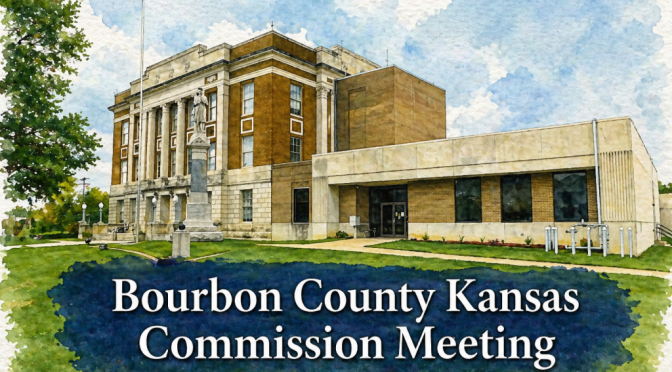
Bourbon County Commission Feb. 23 Agenda Summary

The north wing, east side of the Bourbon County Courthouse.

Bourbon County Commission Meeting Agenda

02.20.26 Agenda

February 23, 2026 | 5:30 PM

  1. Call Meeting to Order

  2. Pledge of Allegiance

  3. Prayer

  4. Approval of Agenda

  5. Accounts Payable – 01.20.26

  6. Citizens Comments

  7. Executive Session

    • K.S.A. 75-4319 (b)(1) – Walker

  8. New Business

    • a. Payentry

    • b. Cemetery & Township Financial Reports

    • c. Unclaimed Property

  9. Commission Comments

  10. Next Meeting Agenda Topics

  11. Adjournment


Information Packet Summary

Accounts Payable and Financial Reports (Pages 2–67) The majority of the packet consists of a detailed “Open Invoices By Department Summary.” This report lists all pending payments and payroll expenditures for various county departments as of February 20, 2026. Key financial highlights include:

  • General Fund (Page 2): Lists standard payroll deductions and benefits such as life insurance, health savings accounts, and federal taxes.

  • Employee Benefits (Page 4): Detailed breakdown of medical and dental premiums for March 2026, totaling over $111,000, along with social security and retirement contributions.

  • Departmental Expenditures:

    • Landfill (Pages 4–5): Includes membership dues, fuel (452 gallons of diesel), and equipment repairs.

    • Sheriff & Correctional (Pages 5–6): Covers vehicle maintenance (oil changes and tire repairs), facility service contracts, and utility bills for the Southeast Kansas Regional Correctional Center (SEKRCC).

    • Road and Bridge (Pages 7–10): Lists extensive commodities purchases, including fuel, vehicle parts, and culvert tubes.

    • Ambulance Service (Pages 10, 27): Covers medical supplies, medications, and contractual charges from the City of Fort Scott.

  • Departmental Payroll (Pages 22–27): Specific wage totals are provided for the County Commission, Clerk, Treasurer, Attorney, Register of Deeds, Courthouse Maintenance, and District Court.

Cemetery and Township Reports (Pages 68–107) The final section of the packet contains the annual financial reports for local cemeteries and townships, which are required by state law (K.S.A. 17-1372) to be filed by January 15.

  • Reporting Requirements (Page 68): Instructions specify that reports must show all money held as of December 31, including investments like CDs or savings accounts.

  • Individual Reports (Pages 90–107): These handwritten forms detail the “Composition of Cash” for various funds. For example, the reports show balances for general funds and permanent maintenance funds, listing receipts from county taxes and expenditures for services like mowing and stone maintenance.

Obituary for Richard Eugene “Richie” Clarkson

Screenshot

Richard Eugene “Richie” Clarkson, age 74, passed away Thursday, February 19, 2026, at his home surrounded by family. Richie was born August 4, 1951, in Ft. Scott, Kansas, the son of Richard Junior “Blackie” Clarkson and Betty Mae “Peggy” Brown Clarkson. He was their only child. Richie graduated from Northeast High School in Arma, Kansas with the Class of 1969. After high school, Richie played basketball for Labette County Community College. Richie worked many years for Midwestern and for B & D trucking before becoming self-employed as a contract mail carrier for thirty-eight years for the United States Postal Service. In addition to hauling mail, he also worked part-time with his dad where he operated heavy equipment and did dirt work. In June of 1990, Richie married the love of his life, Ann; together, they shared a home filled with love, laughter, family, and memories. Richie enjoyed sports; he played recreational basketball, fast pitch for the Shepherd Team Auto Plaza team and also played many years of slow pitch softball. Later, he loved cheering on his grandkids at their various sporting events. Richie enjoyed attending gun shows, going to the races and mowing his yard. He also had a deep love for music and never passed up a sweet treat or breakfast food. He was an animal lover and was especially fond of his beloved pets. Richie was a devoted husband, father, grandfather and friend. He had many interests, but nothing meant more to him than time spent with his family. His presence, humor and love will be deeply missed and forever remembered.

Survivors include his wife, Ann, of the home; three daughters, Tricia Daniels (Darrell) of Overland Park, Kansas, Bryna Boldra (Jeremy) of El Dorado, Kansas and Tiffani Agee (Jason) of Nevada, Missouri; four grandchildren, Landon and Keenan Boldra, Anlee Daniels and Lynlee Agee. He was preceded in death by his parents, Blackie and Peggy Clarkson and his in-laws, Ellsworth and Betty Heckadon.

Following cremation, a celebration of life service will be held at 5:00 P.M. Friday, February 27th at the Cheney Witt Chapel. Visitation will follow the service until 7:00 P.M. Memorials are suggested to Care to Share and may be left in care of the Cheney Witt Chapel, 201 S. Main, P.O. Box 347, Ft. Scott, KS 66701. Words of remembrance may be submitted to the online guestbook at cheneywitt.com.

Bourbon County Local News